Buyer's guide
How to evaluate XR training platforms for hospitals
A practical evaluation guide for hospital clinical educators and simulation leaders
Hospital education teams can judge XR platforms on five areas: AI-powered virtual patients, multimodal access, assessment and analytics, enterprise scalability, and interprofessional team training. Below are the questions to ask vendors in each area and how to test fit with a pilot.
Key takeaways
- Look for AI-powered virtual patients that react to what learners say and do.
- Prioritise platforms that support both VR headset and screen-based learning.
- Check that the platform supports individual practice, instructor-led sessions, and multi-learner team scenarios.
- Automated assessment can reduce faculty workload by tracking learner actions and identifying competency gaps.
- A pilot with your own clinical scenarios is the best test of fit.
XR platform vendor evaluation checklist
Use these questions when comparing vendors. The sections below explain how to evaluate each area.
| Evaluation area | Questions to ask vendors |
|---|---|
| AI-powered virtual patients | Can patients respond naturally to open-ended questions? Can they adapt based on learner actions? |
| Clinical fidelity | Can patient conditions change based on interventions and decisions? |
| Customisation | Can educators modify scenarios without technical support? |
| Access | Does the platform support VR and screen-based learning? |
| Assessment | Are learner actions automatically tracked and mapped to competencies? |
| Team training | Can multiple learners participate with different roles? |
| Scalability | Can the platform support multiple departments and locations? |
| Integration | Does it connect with existing learning systems? |
| Support | What onboarding and faculty training are included? |
| Cost | What are the total costs including hardware, licences, and support? |
What is an XR training platform?
An XR training platform is a digital simulation system that uses extended reality technologies, such as virtual reality and screen-based simulation, to recreate clinical learning experiences. It lets healthcare learners practise assessment, communication, and decision-making with virtual patients that respond to their actions. Learners get more practice than physical labs and instructor time allow.
Hospitals use XR platforms to train healthcare professionals in:
- Clinical decision-making
- Patient communication
- Emergency response
- Team coordination
- Procedural skills
- Competency assessment
What makes XR training platforms different from traditional simulation?
The main difference is that XR removes most of the physical limits on how often and where learners practise. Where manikins and standardised patients need lab space, equipment, and an instructor present, XR lets learners repeat scenarios independently and on demand, so a program can offer far more practice without proportionally more faculty time.
For example, nurses may practise patient assessment and communication in XR before joining an instructor-led team simulation focused on collaboration and debriefing.
Why do hospital educators need clear XR evaluation criteria?
Clear criteria tie your choice to educational outcomes, so you don’t choose technology on features alone. Platforms are built for different jobs: procedures, communication or interprofessional education.
Before evaluating vendors, define who will use the platform, what clinical skills need to be practised, how many learners need access, if training will happen individually or in teams, and how performance will be measured.
The five most important evaluation areas are:
| Evaluation area | Questions to ask |
|---|---|
| AI-powered virtual patients | Can patients respond naturally to learner actions and conversations? |
| Multimodal access | Does the platform run in VR headsets and on desktop, for remote and on-site learners? |
| Assessment and analytics | Can learner performance be automatically tracked and measured? |
| Enterprise scalability | Can the platform support hundreds or thousands of learners? |
| Interprofessional team training | Can learners from different professions train in the same scenario? |
Who should evaluate an XR training platform?
An XR platform should be evaluated by a cross-functional group: clinical educators, simulation leaders, IT and security, leadership, and learners. Each group sees a different part of the picture. Bringing them in early surfaces concerns before deployment and builds the internal support a rollout depends on.
| Stakeholder | What they evaluate |
|---|---|
| Clinical educators | Learning objectives, scenario quality, and how the platform fits teaching workflow |
| Simulation leaders | Facilitation workflow, debriefing support, and alignment with existing simulation methods |
| IT and security | Infrastructure requirements, data privacy, and integration with existing systems |
| Leadership | Scalability, cost, and return on the investment |
| Learners | Ease of use, engagement, and how well the experience supports practice |
How to evaluate AI-powered virtual patient features
Virtual patients are where learners practise conversation and clinical reasoning, so test them closely. Look at how the patient talks, how its condition responds to treatment, and how easily educators can edit the scenario.
Conversational quality
Learners should be able to talk with the patient naturally instead of selecting responses from a fixed script. During demos, ask: Can learners ask open-ended questions? Does the patient respond differently depending on what is asked? Can the patient express emotions such as anxiety or confusion?
For example, a patient discussing smoking cessation should respond differently to supportive motivational interviewing than to a learner who provides information without exploring the patient’s motivation to change.
Lumeto’s InvolveXR has AI-powered patients that respond to what learners say and do, including their clinical decisions. Learn more about how AI-powered virtual patients improve hospital simulation.
Physiological responsiveness
Virtual patients should also respond through changes in clinical condition: vital signs, symptom progression, treatment responses, and deterioration when decisions are delayed. Does administering oxygen improve a patient’s respiratory status? Does delayed intervention result in deterioration? Learners should see what their choices do to the patient.
Scenario customisation
Hospital education teams need to adapt scenarios to local workflows, patient populations, and clinical priorities. Ask if educators can modify patient demographics, medical history, symptoms, and dialogue without technical support. No-code authoring tools let educators update learning experiences as guidelines and policies change, without waiting on the vendor.
What multimodal access options should you look for?
Look for a platform that supports both VR headset and screen-based delivery, plus remote and on-site access. Learners can then train from a simulation centre, a classroom, a ward, or home. Hospitals rarely have one ideal training environment or a headset for each learner.

VR headset training
VR places learners in a three-dimensional space with virtual patients, clinical settings, and equipment. It suits experiences that need spatial awareness, clinical prioritisation, team coordination, and detailed patient encounters.
Ask which headsets are supported, if devices are standalone, how long setup takes, and how devices are managed across sites. Complex setup can stop educators from running training on their own.
Screen-based simulation
Screen-based access lets learners join interactive scenarios on a computer or tablet without a VR headset. It works well for remote learners, large cohorts, pre-simulation preparation, and practice outside scheduled sessions.
At New Brunswick Community College, educators combined VR and screen-based learning with manikin simulation to deliver pediatric simulation training for 46 nursing students across campuses. The blended approach supported 22 hours of accredited clinical learning. Read the New Brunswick Community College case study.
How to assess XR platform scalability for enterprise deployment
Assess scalability by checking support for synchronous and asynchronous learning, multi-learner training in defined roles, and how easily administrators can manage users and track completion across departments and sites.
Healthcare teams work around complex schedules. Synchronous sessions suit team simulations, facilitated practice, and group debriefing. Asynchronous learning suits onboarding, skills reinforcement, remediation, and shift-based training. Many hospitals use both.
What assessment and analytics features matter most?
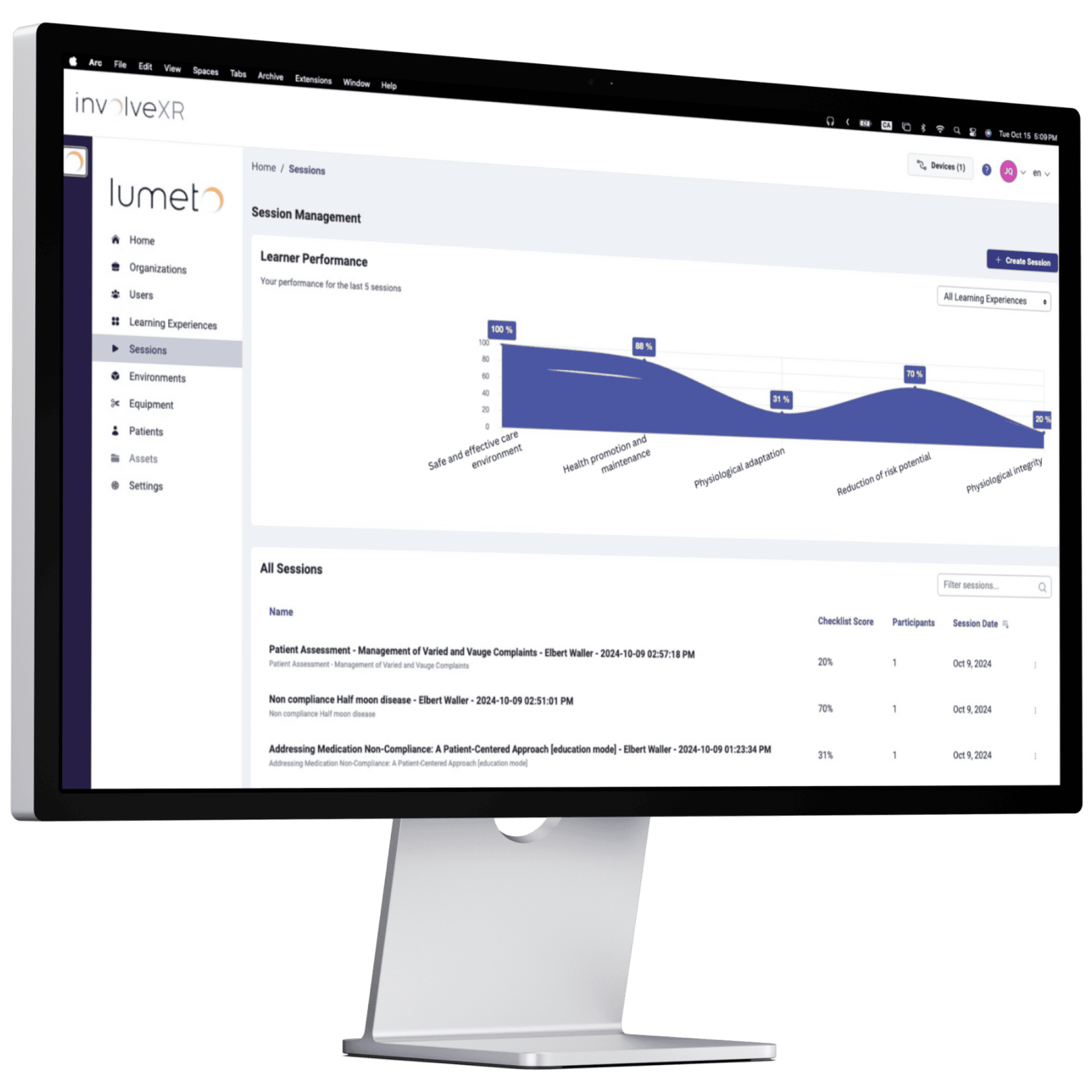
The assessment and analytics features that matter most are automated performance tracking, competency mapping, progress analytics, and debriefing support. These show if a platform can measure learning and save faculty time.
Automated performance tracking
Automated assessment reduces the need for faculty to observe each learner action. Look for tracking of clinical decisions, communication behaviours, timing of interventions, and scenario outcomes. The platform should show if the learner assessed the patient appropriately, recognised deterioration, and completed the required interventions.
Lumeto’s InvolveXR includes the Artificial Clinical Evaluator (ACE), which tracks learner actions during simulation and shows educators where each learner has competency gaps.
Competency mapping
Programs often need to show that training aligns with professional standards. Educators should be able to connect simulation activities to institutional competencies, accreditation requirements, and assessment criteria. Ask if checklists and competency categories can be customised, if results can be exported, and if performance can be compared over time.
AI-assisted debriefing
The debrief is where much of simulation learning happens. AI-assisted tools can point out key decision points and communication patterns worth discussing, while the educator still leads the debrief and gives feedback. See how AI is extending clinical debriefing beyond the classroom.
How to evaluate team training fit for hospital environments
For hospitals, the platform should let different healthcare roles train together in one scenario. Look for role assignment, team communication, shared decision-making, and individual performance tracking.
Role assignment and coordination
Healthcare teams depend on clear responsibilities. Check if educators can assign roles such as team leader, medication administrator, airway manager, and documentation lead. Ask how many learners can participate at once and if performance is tracked individually.
Communication skills development
Communication is hard to practise with large groups. AI-powered virtual patients let learners practise patient education, difficult conversations, and shared decision-making. Look for platforms that assess behaviours such as introducing themselves, confirming understanding, and using closed-loop communication.
Psychological safety in virtual environments
XR environments can create psychological safety by letting learners practise without the pressure of performing in front of peers or standardised patients. Learners are then more likely to ask questions and try things they are unsure of.
A 2025 study in Clinical Simulation in Nursing (Harder et al.) comparing AI-enhanced VR simulation with standardised patient encounters found that nursing students reported reduced performance anxiety and valued the immediate feedback and self-paced practice of the virtual environment. Standardised patients remained stronger for emotional and interpersonal authenticity. (Harder et al., 2025)
What questions should you ask during an XR platform demonstration?
Ask about setup and onboarding, integration with existing systems, and total cost of ownership. A demo shows a platform under ideal conditions, so these questions help you see how it will work in your clinical environment.
Setup and onboarding
Ask how long deployment takes, what hardware is required, what technical support is provided, how updates are managed, and how much training educators need. Clinical educators are focused on teaching, so heavy technical demands can limit adoption.
Integration with existing systems
Check if the platform supports learning management system integration, user management, completion tracking, assessment exports, and reporting dashboards. Integration reduces administrative work and shows training outcomes across departments.
Pricing and total cost of ownership
The cost of an XR platform includes hardware, licensing, content access, faculty training, technical support, implementation time, and long-term maintenance.
Compare that against traditional simulation costs, including lab availability, manikin maintenance, standardised patient programs, and faculty time. Rigorous return-on-investment data in simulation remains limited, and cost-effectiveness depends heavily on learner volume and how fully a program uses the platform (Advances in Simulation, 2016).
How should hospitals structure an XR platform pilot?
Structure a pilot in four steps: select representative use cases, include diverse stakeholders, measure outcomes that matter, and test edge cases. A pilot shows if the platform works in real conditions before large-scale deployment.
1. Select representative use cases
Choose scenarios that reflect your organisation’s priorities. For nursing education, this may include patient assessment, communication skills, and clinical deterioration. For interprofessional training, consider emergency response, patient handoffs, and team coordination.
2. Include diverse stakeholders
Gather feedback from educators, simulation leaders, IT, leadership, and learners. In a pilot, each group is testing if the platform holds up in day-to-day use.
3. Measure outcomes that matter
| Category | Example measurements |
|---|---|
| Adoption | Number of learners completing scenarios |
| Usability | Learner and faculty satisfaction |
| Efficiency | Faculty time required per learner |
| Learning | Assessment results and competency improvement |
| Operations | Technical issues and support requirements |
4. Test edge cases
Vendor demonstrations usually show expected behaviour. Test what happens when learners ask unusual questions or take incorrect actions, when connectivity drops, and when educators need to recover from mistakes.
How do XR training platforms differ?
Platforms are built for different purposes, so the right one depends on what your learners need to practise.
There is no single industry-standard framework for evaluating simulation technology. The Society for Simulation in Healthcare has noted that the field still lacks a widely accepted model for assessing simulation tools before implementation. Weigh independent evidence, clinical validation, and implementation support alongside feature lists.
Domain-specific vs general XR platforms
| Platform focus | Best suited for |
|---|---|
| Procedural training | Technical skills and specific procedures |
| Communication training | Patient interactions and therapeutic conversations |
| Team simulation | Interprofessional collaboration |
| General healthcare education | Clinical skills across many areas |
Pre-built content vs customisation
Pre-built libraries deploy faster and have been tested, though they may not match your workflows. Building your own scenarios fits local needs but takes authoring tools and educator time. Lumeto’s InvolveXR has a clinician-curated library of competency-mapped Learning Experiences, and educators can adapt them with its customisation tools.
What should hospitals plan for when implementing XR?
Beyond the technology, plan for these four areas:
- Faculty development: XR shifts the educator role toward facilitation, coaching, and debriefing. Provide platform training, time to practise, and ongoing support.
- Equipment management: plan device storage, charging, cleaning, and equipment tracking before launch.
- Change management: explain why XR is being introduced and where it fits alongside existing simulation. Share pilot results to build confidence.
- Sustainability: plan for content updates, hardware replacement, and expansion across departments. Budget for it as an ongoing cost.
Before you choose a platform
Four steps before you sign with a vendor:
- Define your training goals.
- Evaluate vendors against clear criteria.
- Pilot real clinical scenarios.
- Choose the platform that held up best in your pilot.
Frequently asked questions about evaluating XR training platforms
What is the difference between XR simulation and traditional simulation?
The core difference is the equipment. XR simulation uses VR and screen-based digital environments to recreate clinical scenarios, while traditional simulation typically relies on physical equipment such as manikins or standardised patients. With XR, learners can repeat scenarios on their own, often without dedicated lab space or faculty supervision.
Is XR training effective for healthcare education?
Yes, with conditions. Studies of XR in healthcare education report gains in learner engagement, confidence and clinical reasoning, plus more chances to practise. Its effectiveness depends on scenario design, learning objectives, assessment methods, and how the technology is integrated into the broader curriculum.
A 2025 study in Clinical Simulation in Nursing (Harder et al.) comparing AI-enhanced VR simulation with standardised patient encounters found that nursing students reported reduced performance anxiety and valued the immediate feedback and self-paced practice of VR, while standardised patients remained stronger for emotional and interpersonal authenticity. The authors concluded AI-enhanced VR is an effective complement to traditional simulation. In a separate IRB-approved study, the American College of Chest Physicians (CHEST) evaluated a difficult airway management course built on Lumeto's InvolveXR platform across Mayo Clinic, NYU, and Wake Forest with 39 participants; after a single session of roughly 25 minutes, learners showed a 16% relative increase in procedural knowledge overall, rising to 26% among residents.
Sources: Harder et al., 2025; CHEST pilot study.
Can XR replace simulation labs?
No. XR extends simulation capacity and works alongside traditional simulation. Hospitals can use XR for repeated practice, clinical decision-making, communication training, pre-simulation preparation, and large-scale learner access. Traditional simulation still matters for hands-on procedures, physical equipment practice, and facilitated team debriefing.
Can XR training count toward nursing clinical hours?
It depends on the jurisdiction. In the United States, the NCSBN National Simulation Study (Hayden et al., 2014) found that well-designed simulation could be substituted for up to 50% of traditional clinical hours without negatively affecting educational outcomes, NCLEX pass rates, or preparation for practice. Many state boards now permit simulation to replace a defined share of clinical hours, though the exact percentage varies by state. In Canada, CASN's Guidelines for Clinical Placements and Simulation address how simulation and placements together meet learning outcomes, with substitution limits set provincially. Programs should confirm current requirements with their own regulator or accreditation body and make sure XR activities include defined learning objectives, assessment, and documentation.
Sources: NCSBN National Simulation Study; CASN Guidelines; HealthySimulation state tracker.
How long does it take to implement an XR training platform?
It depends on your organisation's size, technical requirements, and training goals. Hardware setup, faculty training, scenario selection, IT approval, and integration all affect the timeline. A pilot lets you find and fix problems before a wider rollout.
How do XR platforms handle situations AI cannot simulate?
Judge AI simulation on what it teaches, since no platform recreates each clinical detail. Where the technology falls short, educators can build the scenario around the learning objective. For example, if a physical finding cannot be visually represented, educators can incorporate verbal assessment cues or clinical information into the scenario.
What metrics should hospitals track after implementing XR training?
Hospitals should measure both learning outcomes and operational results. Important metrics include learner completion rates, competency assessment results, confidence changes, faculty time requirements, scenario usage, learner satisfaction, and deployment across departments. A good rollout should show gains in both teaching quality and training capacity.