
AI Clinical Debriefing in Every VR Simulation
Moments earlier, she had assessed a patient presenting with chest pain. The ECG showed subtle changes. The patient’s blood pressure was trending downward. She ordered oxygen, initiated monitoring and debated whether to escalate care immediately or gather more information.
The scenario ended before she felt entirely certain of her decisions.
She does not remove the headset.
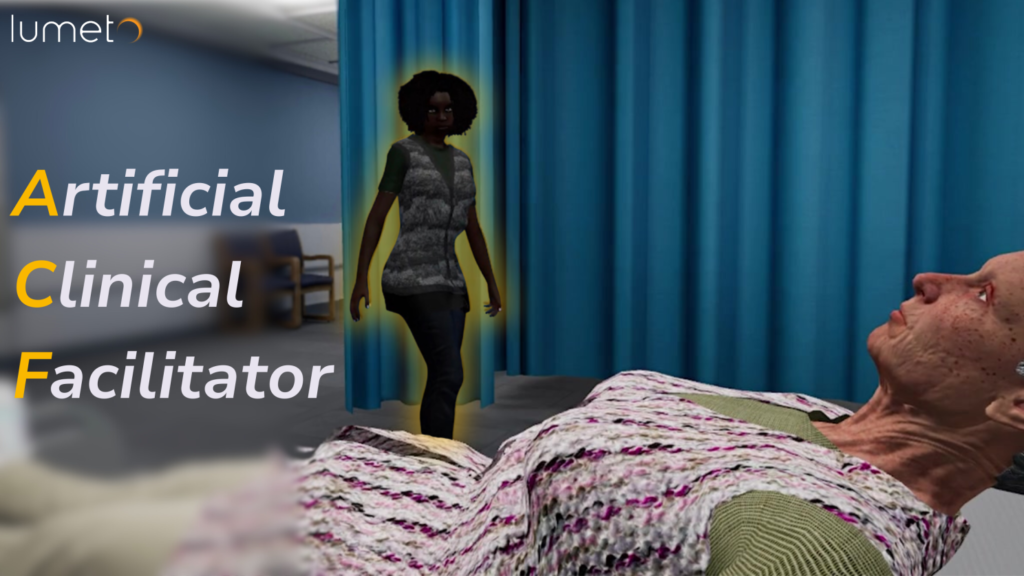
Instead, a clinical facilitator appears in the virtual room.
Calm. Present. Measured.
“Walk me through what you were noticing when the patient’s blood pressure began to drop.”
The student exhales and begins.
This exchange is not happening in a classroom after the simulation. There is no faculty member waiting outside the lab. The facilitator she sees is InvolveXR ACF, Lumeto’s Artificial Clinical Facilitator, embedded directly inside the virtual experience.
For decades, simulation-based education has revolved around a simple truth. The learning is not in the scenario. It is in the debrief.
High-fidelity mannequins, standardized patients and immersive VR have transformed how future clinicians practice. But educators have long cautioned that realism alone does not produce insight. Without structured reflection guided by a skilled facilitator, learners may complete a case without fully examining their reasoning.
Debriefing is where clinical judgment is unpacked. It is where cognitive biases are surfaced. It is where confidence is recalibrated. It is also one of the most time-intensive and difficult elements of simulation to scale.
ACF is Lumeto’s attempt to address that gap, not by replacing facilitators, but by extending their presence into self-directed and asynchronous learning.
A Facilitator, Designed by the Facilitator
Lumeto describes ACF as the industry’s first Artificial Clinical Facilitator, an AI-powered facilitator persona embedded in both immersive VR and screen-based simulations.
But the company is precise about what ACF is and what it is not.
It is not a chatbot. It does not replace faculty.
Instead, ACF functions as a faculty-authored extension. It carries a specific educator’s methodology, tone and expectations into moments when live facilitation is not available.
Programs configure ACF themselves. A facilitator defines the debrief framework, whether advocacy-inquiry, PEARLS or a customized hybrid. They set learning objectives, determine the depth of reflection and shape the tone of questioning. The result is not generic AI conversation, but a facilitator presence intentionally modeled after the educator it represents.
ACF does not invent pedagogy. It operationalizes it.
In that sense, it is less a substitute and more a continuation. A way for an educator’s voice and structure to persist beyond scheduled sessions.
Inside the Headset
“What differential diagnoses were you considering at that point?” the facilitator asks.
The student gestures toward the ECG tracing. “I was thinking acute coronary syndrome, but I wasn’t sure if the changes were significant enough.”
“What information would have increased your confidence?”
The exchange unfolds conversationally but deliberately. Questions are sequenced to probe clinical reasoning. Assumptions are examined. Alternative actions are explored. The learner is not graded or corrected in real time. Instead, she is guided to articulate her thought process.
Educational research has emphasized the importance of psychological safety in debriefing. Learners must feel able to admit uncertainty without fear of embarrassment. Lumeto draws on findings from a University of Manitoba study of its AI-enabled patient interactions, which suggested that learners often reported feeling less judged and more willing to take risks when interacting with AI.
ACF builds on that foundation. The facilitator persona is designed to be supportive and steady, reinforcing that reflection is about growth rather than evaluation.
When the conversation concludes, the student removes the headset. The debrief has already taken place.
Beyond VR
Not every learner trains in immersive virtual reality.
Across healthcare programs, screen-based simulations and asynchronous modules are increasingly common. A paramedic student completing coursework from home may work through a pediatric assessment case on her laptop. She evaluates vital signs, selects interventions and documents her rationale.
The case closes.
In many programs, that is where the learning would traditionally end.
With ACF, a facilitator appears within the simulation interface.
“Tell me what findings most influenced your initial impression.”
The student types her response. The facilitator replies with structured follow-up questions aligned with the program’s chosen debrief model. The exchange is adaptive and purposeful. Each question is designed to deepen reasoning and connect actions to outcomes.
Here, too, the facilitator reflects the educator’s design. The tone, prompts and emphasis are defined by the program. The AI delivers structured reflection consistent with how faculty would guide it in person.
Self-directed learning becomes guided learning.
Scaling Without Diluting
The introduction of AI into education inevitably raises questions. If a digital facilitator can conduct debriefs, what becomes of the human one?
Lumeto’s answer is straightforward. ACF is designed for scalability, not substitution.
Live, expert-led debriefing remains the gold standard. In scheduled simulation sessions, educators continue to lead discussions, respond to nuance and adapt in real time.
But simulation programs face growing class sizes, distributed campuses and limited faculty bandwidth. It is not feasible for every self-directed scenario, every late-night practice session and every asynchronous module to include live facilitation.
ACF ensures that reflection does not disappear when faculty are not present.
It provides consistency across learners. Human facilitation, while nuanced and powerful, can vary depending on time constraints and experience. ACF delivers framework-aligned debriefing every time, according to parameters set by the educator.
Every learner receives structured reflection. No one simply completes the scenario and moves on.
A Different Use of AI
The broader conversation about artificial intelligence often centers on automation. Replacing tasks. Reducing labor. Increasing speed.
ACF reflects a different application.
It does not automate grading. It does not generate generic feedback summaries. It embeds structured pedagogy directly into the learning experience.
As simulation technology becomes more immersive and visually sophisticated, there is a risk that education prioritizes realism over reflection. Lumeto’s approach suggests that the true innovation may not be what learners see during the case, but what happens immediately after.

Back in the virtual emergency department, the student answers one final question.
“What will you carry forward into your next patient encounter?”
She pauses, still surrounded by the digital room.
The facilitator waits.
And in that pause, between action and insight, the purpose of simulation becomes clear.