How Penny Anderson gamified nursing assessments at NBCC
When Penny Anderson watched her nursing students perform head-to-toe assessments, she started questioning how they were practising.
They knew the rubric.
Maybe too well.
“When they came to demonstrate in front of us, they were actually really regurgitating back the rubric word for word,” Penny said. “So do they really know it, or are they just memorising it?”
At New Brunswick Community College (NBCC), Penny decided to change how the assessment worked.
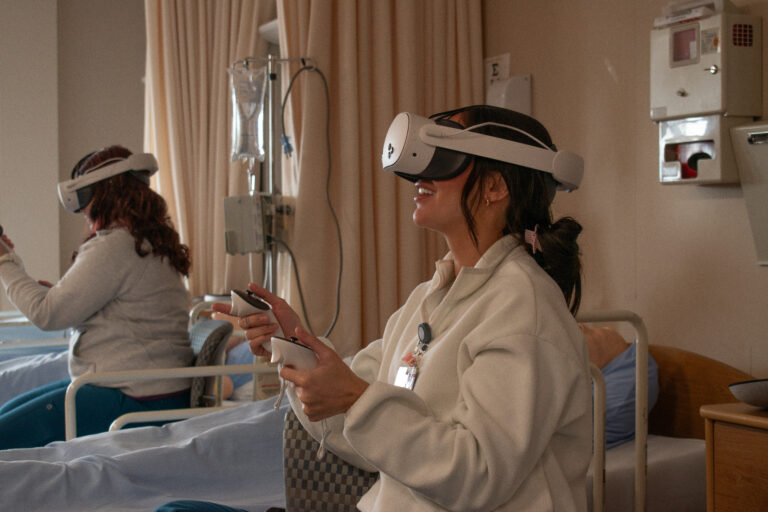
Students would still practise individual assessment skills with an instructor. But when it was time to demonstrate a full head-to-toe assessment, they had to do it independently in InvolveXR, without the rubric or the usual instructor prompts.
The goal was clearer proof of what students could do on their own.
Practise in the lab, prove it in the headset
Penny had seen how easy it was for instructors to help students through a difficult assessment.
“We want our students to be successful,” she explained. “When they struggle at a certain point… we always give them little hints.”
The problem was what happened later.
“When they get out at clinical, those things that they missed in the lab, they’re missing out at clinical.”
So Penny moved the support earlier in the process.
Students could practise individual assessments with an instructor, repeat scenarios, and get comfortable with the technology. But the final head-to-toe assessment required them to know it themselves.
No one in the room was going to tell them what they had forgotten.
The setup also let Penny manage more students at once, reducing the instructor time required for each individual assessment. She could run as many as nine students at the same time.
A first score was a starting point
Penny built repetition into the experience.
Students could attempt a scenario, review what happened, and try again. A first score of 2 was simply the first attempt.
“I don’t want you to take that score literally,” Penny told her students.
One reason was that the AI did not always recognise an answer when a student used different wording from the phrasing in the checklist. Penny would review the transcript, look at what the student actually said, and confirm the intended response herself.
The score became something students could work with.
One student started with a score of 2.
She kept practising.
By the end of the term, she reached 75.
“Penny, I never thought in a million years I could do this.”
That was the outcome Penny was looking for: students getting enough attempts to see their own progress.
Taking the checklist away
Penny initially made the checklist available inside the VR experience.
It quickly became a distraction.
Students were spending more time scrolling through the checklist than assessing their patient. So Penny removed it from the final assessment.
Her message to the students was simple:
“You’re a nurse. You don’t have a checklist when you go into the room. You need to know your stuff.”
Students found it uncomfortable at first. But the change pushed them to rely on what they knew.
That shift also changed what Penny could see: how students responded when they had to make their own decisions.
Scenarios that push past the obvious
Penny also designed scenarios that asked students to look beyond what the checklist covered.
In one case, the patient had pneumonia and a history of stroke from three months earlier. There was also a subtle facial droop.
Some students completed the expected assessments but didn’t connect those details.
Penny used the scenario to push them further.
Did they notice the change in the patient’s face? Did they verify the history with the patient? Did they ask the next question?
“It was almost like a light bulb moment,” Penny recalled. “Okay, I get it. Do you think I just wanted you to do a neuro assessment? There had to have been something wrong with your patient.”
The scenario asked students to notice when something in the patient’s story should change what they did next.
The prompts evolved with the students
The experience wasn’t perfect from the beginning.
Penny found that students sometimes demonstrated the right knowledge using words that didn’t match the checklist closely enough for the system to catch them. So she began refining the AI prompts, which define the AI-enabled checklists in the platform, based on what she saw in the lab.
Some changes were small but important.
When students introduced themselves without stating their designation, Penny added a prompt for “PN student.” When an assessment required hand hygiene at two points, she adjusted the checklist so both were caught.
She also worked with lab leads across campuses to align the language used in the simulation with the language instructors were teaching.
The result was an iterative process: students used the scenario, Penny observed what happened, and the content was adjusted accordingly.
Her advice to other educators is direct.
“It’s not hard to do. It can take some time at the beginning. And once you have it, it’s great. You can change it however which way you want.”
Making sure VR doesn't become the barrier
Penny also learned that not every student would experience VR the same way.
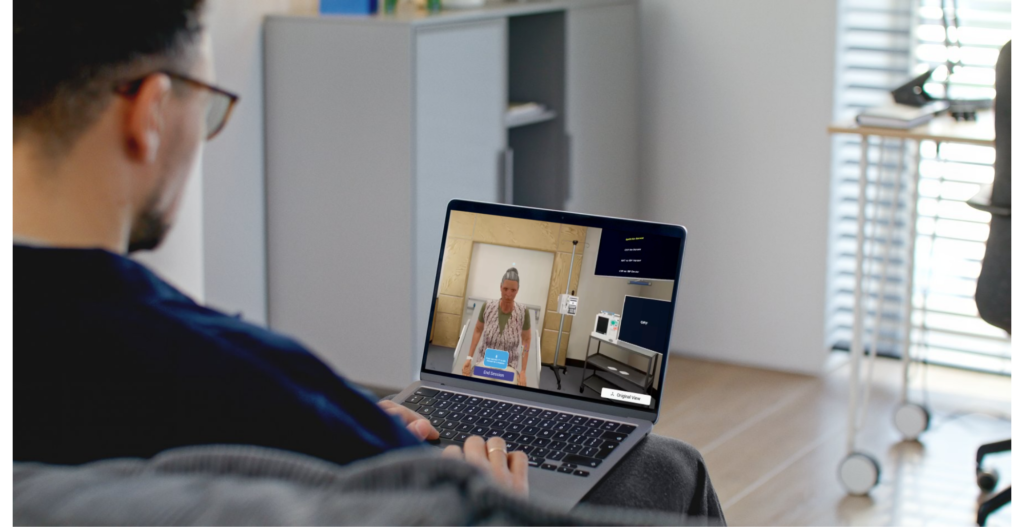
Some students experienced vertigo and couldn’t tolerate the headset, so she introduced screen-based simulation so they could continue practising alongside their classmates.
She also came across situations where speech recognition did not pick up a student’s pronunciation, based on their dialect, accurately. In those cases, Penny treated VR as a practice environment, and provided an instructor-led option for the final assessment.
The point was to give students more chances to practise.
What this really changes
Penny’s work at NBCC is about changing what happens between “I learned this” and “I can do this independently.”
Students get chances to practise. They can revisit a scenario, review what happened, and try again. There’s no one-and-done pressure on the final assessment.
And Penny gets to see something she couldn’t always see when students were reciting a rubric: how they think through the patient in front of them.
She reports that students were stronger when they reached clinical because they had to rely on their own knowledge.
Her next step is to finish refining her head-to-toe assessment and share it with other educators so they can adapt it to their own competencies.
The most useful part of Penny’s approach may be the idea behind it:
Gives students a safe place to practise and chances to try again and challenge themselves.