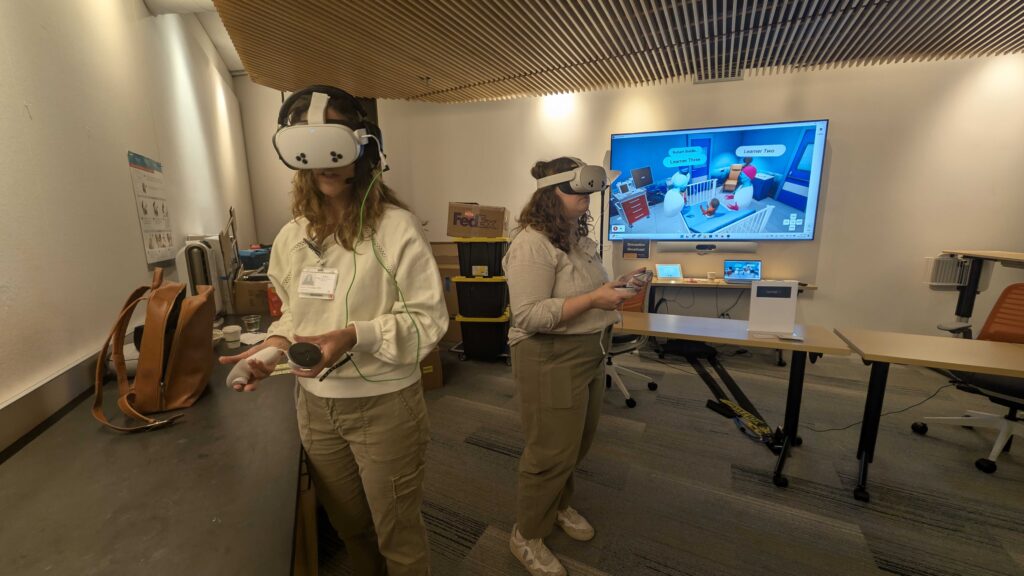
At a simulation webinar earlier this month, one of the industry’s established organizations ran a live XR clinical skills demo in front of a room of educators. Not a recorded clip. Live.
A demo like that only happens when an organization is confident the technology will hold up. It’s a signal of where XR simulation is heading.
XR simulation proved itself first in nursing scenario training: complex clinical situations, team response, and communication under pressure. Now it is extending into procedural and specialty skills. Things that once required a manikin or physical trainer are starting to appear in VR and mixed reality.
That creates new opportunities for simulation programs. It also creates a sourcing problem in the making.
The point-solution problem
As XR reaches new clinical areas, the natural move is to evaluate a purpose-built tool for each one: a solution for one procedure, another for nursing scenarios, and a screen-based option for something else.
Each solution may be valuable on its own. Together, they’re harder to manage: different platforms, different workflows, different training requirements, and different vendor relationships. And every one is a separate decision, so you’re never building toward anything. Each purchase solves one skill and adds one more thing to manage.
Many programs end up repeating the same evaluation again and again. Over a few budget cycles, they find themselves running several platforms that don’t connect, each with its own implementation needs and renewal decisions.
What a platform approach looks like
Programs that build around a comprehensive XR platform early are in a stronger position. When a new clinical area becomes available, they can extend what they already have.
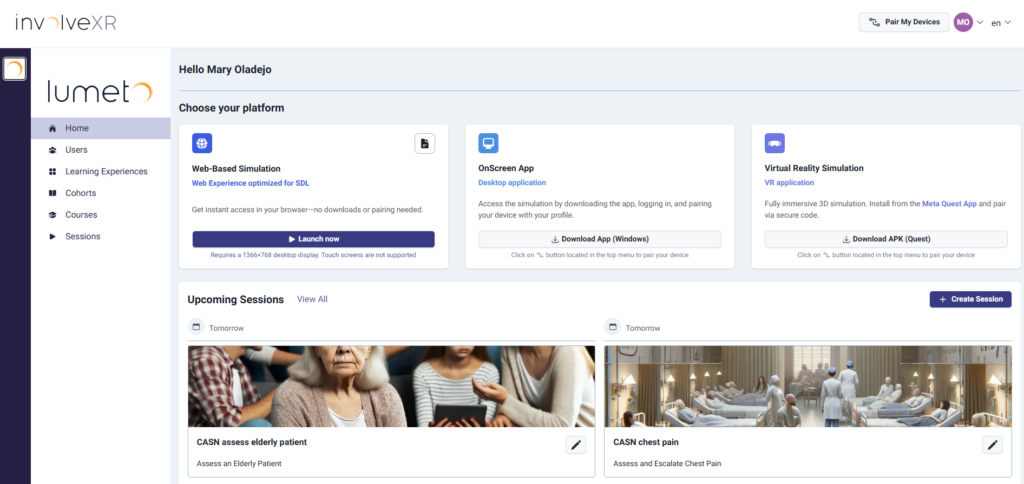
InvolveXR supports nursing, pediatrics, mental health, and high-acuity scenarios through instructor-led and self-directed experiences, available in VR and on screen. With a growing library of clinical scenarios and the ability to customize experiences to match program needs, educators can expand simulation across different learning objectives while keeping everything within one connected environment.
As XR continues to move into more clinical skills, the question shifts. It becomes less about which tool to add next and more about how to build a simulation environment that can continue to grow with your program.
If you’re mapping out how XR simulation can cover more clinical skills across your program, we’d be glad to show you what that looks like.
Elevate Your Healthcare Program with AI-Enabled Immersive Training
InvolveXR delivers simulation of real procedures and patient interactions with lifelike scenarios enhanced by AI.