
One patient, one team, one repeatable flow
Ashley didn’t bolt VR onto her curriculum. She built a workflow around it, one every student now repeats for every case.
01
Pre-encounter review
A one-hour lecture, then a mock EMR with just enough information to get differential diagnosis started.
02
Group encounter
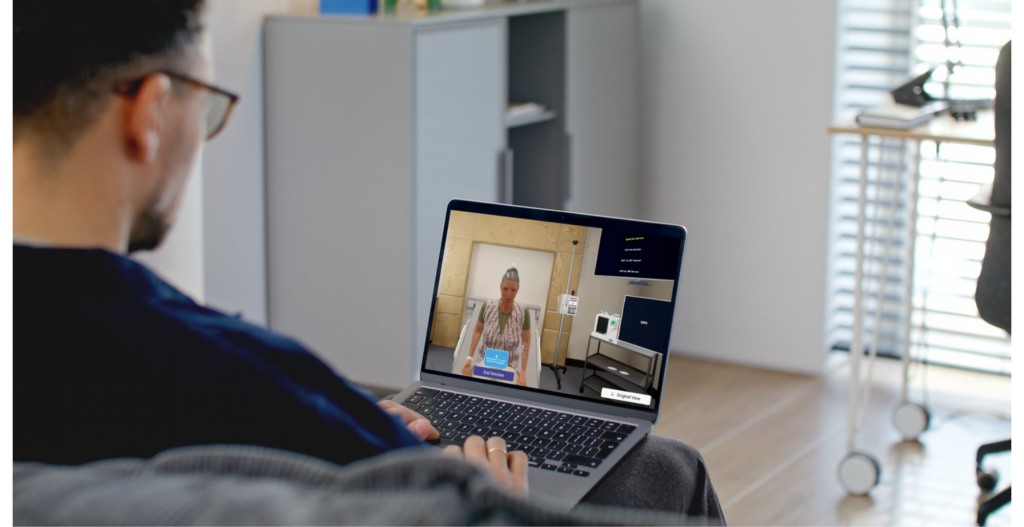
Teams of three run a 30-minute screen-based InvolveXR case: one provider, two supporting with reasoning and notes.
03
Verbalized physical exam
Students talk through the exam InvolveXR can not yet capture, then complete a hands-on lab graded on the same case.
04
Oral presentation and SOAP note
A 15-minute prep window, then a graded oral presentation and a collaborative SOAP note the team writes together.
05
Immediate debrief
Run right after the case, while it is still fresh, so students can ask why a specific finding mattered.
"I really was intentional in not trying to put too much on technology, in terms of making technology the make-or-break of the entire session. I wanted to create a process for the students where it was a tool they used to develop that process."
Ashley Mellert, University of Charleston PA Program
Teaching the AI to teach
One of the more specific choices Ashley made: she worked directly with Lumeto’s Customer Success team to change how the AI patient responded to bad questioning.
Students, it turns out, love to rattle off a list: “Any shortness of breath, chest pain, wheezing?” Answering all three at once teaches nothing. So Ashley tuned the AI’s parameters so the patient would only answer the last question asked in a run-on string, whatever it was. If students wanted the full picture, they had to ask one targeted question at a time, the same skill they will need in the exam room and on rotations.
That kind of plain-text customization, adjusting how the AI patient responds without touching code, is the same lever any InvolveXR customer can pull. Ashley used it again for sensitive scenarios like suicidal ideation, where she wanted every student to get the exact same, carefully worded response regardless of how the question was phrased. Standardized patients are great, but even well-trained SPs interpret a scenario a little differently. The AI did not.
A little anxiety helps. A lot of it doesn’t.
Ashley was working with an especially anxious cohort, and she was rolling out new technology herself at the same time. Her approach was blunt honesty: she told students exactly what this was for, a low-stakes way to get reps in before a graded encounter counted against them, and she asked for specific feedback all semester instead of vague complaints.
It worked well enough that by the end of the semester, students were asking for the opposite of less technology: earlier access. Several told Ashley they wished they’d had these cases in their very first semester, before they’d even learned the basics of taking a history.
Faculty noticed the same shift Ashley did. In the current semester, students who came through the InvolveXR workflow are showing up to standardized patient encounters with better organization, cleaner documentation, and a flow that used to take much longer to develop.
"It really helped me not be so nervous to make mistakes, and provided a safe opportunity to say things that didn't make sense, or figure out how to word something as sensitive as asking a patient if they've harmed themselves, without the awkwardness of never having asked another human being that before."
Ashley Mellert, on student feedback
Start with your objectives, not the tool
When asked what she’d tell another program considering this, Ashley didn’t talk about the technology first.
"Look at your objectives, figure out what you're trying to achieve, and then build the platform, or use the platform, around those objectives. Not vice versa."
Ashley Mellert
Her second piece of advice: don’t expect one tool to do everything. InvolveXR gave her students a safe, repeatable way to practice history-taking and clinical reasoning as a group. It didn’t replace the hands-on physical exam lab, the SOAP note practice, or the standardized patient encounters that still anchor the program. It filled a specific gap, one Ashley identified before she ever opened the platform.
From group encounters to individual ownership
This semester, Ashley’s students moved from group-based InvolveXR cases to individual encounters, the next rung on the ladder toward standardized patients and clinical rotations. She’s now planning a formal survey of the program’s standardized patients, asking whether they can tell the difference in communication and flow between students who trained with InvolveXR and those who didn’t.
If the data holds up as the anecdotal feedback suggests, Ashley’s next step is straightforward: expand the same workflow into more courses and give faculty back the time they used to spend on live grading oversight.
Elevate Your Healthcare Program with AI-Enabled Immersive Training
InvolveXR delivers simulation of real procedures and patient interactions with lifelike scenarios enhanced by AI.