
The Scarcest Resource In Nursing Education Is Not Technology, It’s Time.

On a Tuesday afternoon in a mid-sized nursing program, the simulation lab is booked solid. The manikins are warm, the scenarios are written, the students are ready. What the schedule cannot produce is a third faculty member. One instructor is running a debrief that has gone long. Another is covering a clinical site across town. The lab coordinator looks at the waitlist of students who need their simulation hours and starts moving names to next month.
This scene repeats in nursing programs everywhere, and it explains a quiet shift now underway across healthcare simulation. The industry has spent a decade making virtual training more realistic. It is now racing to make it less dependent on the people who run it.
The Bottleneck Was Never the Headset
The arithmetic of traditional simulation is unforgiving. Every scenario needs someone to voice the patient, advance the case, watch the clock, and lead the debrief. Faculty time, not lab space or technology budget, sets the ceiling on how many simulation hours a program can deliver. As enrollment pressure grows and clinical placements stay scarce, that ceiling gets lower relative to demand every year.
Vendors have noticed. Across the simulation market, the newest product announcements share a theme: artificial intelligence that takes over parts of the facilitator’s job, so educators can supervise more sessions with less hands-on effort. Conferences and industry gatherings increasingly frame the conversation around readiness and capacity rather than fidelity and realism. The question has moved from “how lifelike is the simulation?” to “how many learners can we actually put through it?”
This is the right question. But it invites a sharper one.
Assisted Is Not The Same As Independent
There is a meaningful difference between technology that helps an instructor run a session and technology that lets a session run without one. Assistance lightens the load. It does not change the arithmetic. If an educator still needs to be present, observing and ready to step in, then every simulation hour still consumes a slice of faculty time, and faculty time is still the constraint.
Truly self-directed simulation changes the equation. When a learner can enter a scenario alone, talk with an AI patient that responds conversationally rather than from a menu, make clinical decisions, and receive a structured, AI-driven debrief at the end, the session no longer draws on the faculty schedule at all. Students practice at ten at night or six in the morning. The waitlist stops being a function of the staffing roster.
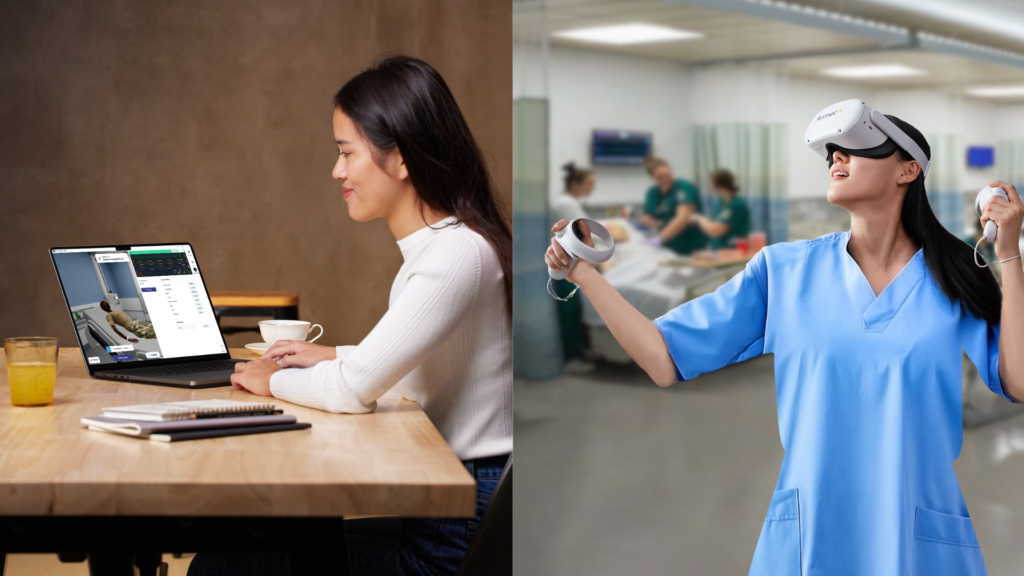
This is the standard simulation leaders should hold any platform to, including ours. At Lumeto, self-directed delivery is not a feature bolted onto an instructor-led product. InvolveXR was built to run both ways from the start: fully facilitator-free sessions on a headset or a laptop screen when capacity is the problem, and rich instructor-led sessions, with on-the-fly scenario control, when faculty want to be in the room. The same scenarios, the same AI patients, the same assessment and debrief, in whichever mode the day’s schedule allows.
Before You Buy
Questions that cut through the noise
For programs evaluating simulation platforms this year, three questions reveal whether a platform is genuinely built for scale — or just dressed to look like it is.
Can a learner complete a full scenario, including the debrief, with no educator present?
Does the self-directed mode use real conversation, or are menus standing in for it?
Can your faculty adapt scenarios to your curriculum, or are you buying a fixed catalog?
The programs that thrive over the next five years will not be the ones with the most impressive technology demos. They will be the ones that turned their scarcest resource, faculty time, into a choice rather than a constraint. The technology to do that exists today. The arithmetic is waiting to change.
To see what fully self-directed simulation looks like in practice, book a short intro call with me.