Rethinking Clinical Rotations : A New Way Forward
A System Under Pressure
The challenges are not the result of a single failure, but of compounding pressures.
Hospitals and clinics, stretched by rising patient loads and staffing shortages, have less time to teach. Students, meanwhile, are more numerous than ever, competing for limited placements. In many settings, hands-on learning has quietly given way to observation.
“Sometimes you’re there, but you’re not really doing anything” said one nursing student, describing long hours spent watching rather than participating.
Even when opportunities arise, they are shaped by chance. A student might encounter a wide range of conditions , or miss key experiences entirely.
This variability is particularly evident in areas like pediatrics. Ethical considerations and patient vulnerability often limit student interaction with children, leaving many trainees with little direct exposure.
At the West Virginia School of Osteopathic Medicine, one student reflected on something: Immersive simulation through InvolveXR gives students hands-on preparation on pediatric care, which are typically hard to simulate, before their clinical rotations, so when they step into real pediatric encounters, they arrive ready.
The issue extends beyond age groups. Exposure to diverse patient populations , across cultures, conditions and communication needs , is often inconsistent, shaped more by geography than by curriculum.
The Limits of Learning on the Job
Clinical education has always depended on real patients, with all their unpredictability. But that strength has become a limitation.
Patient safety rightly constrains what students can do. High-acuity cases move quickly, leaving little room for teaching. And mistakes, an essential part of learning, carry real consequences in clinical environments.
The result is a paradox: students are expected to be practice-ready, but are often shielded from the very experiences that build readiness.
“No two students graduate with the same level of exposure,” said one medical educator. “And that’s increasingly a problem.”
A Shift Toward Immersive Training
In response, some institutions are turning to immersive technologies to complement traditional rotations , not to replace them, but to make them more reliable and equitable.
Among these approaches is Lumeto, a platform that places students inside simulated clinical environments where they can interact with virtual patients, make decisions and experience the consequences in real time.
Unlike traditional simulation labs, which can be resource-intensive and limited in scale, immersive training allows for repeatable and standardized scenarios. A pediatric emergency, a complex communication case or a culturally nuanced interaction can be practiced multiple times, by every student.
And increasingly, that training is not confined to headsets.
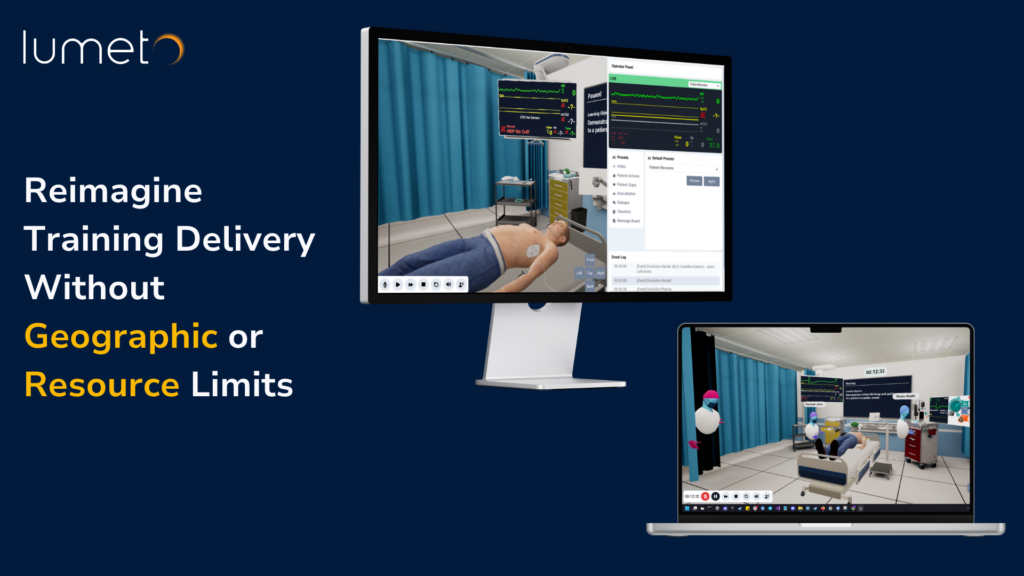
Lumeto has expanded its platform to include screen-based training, allowing learners to access the same scenarios through laptops and desktops. The shift reflects a broader recognition: for simulation to address systemic gaps, it must be as accessible as it is realistic.
Screen-based delivery lowers barriers to entry, making it possible for institutions to scale training across cohorts, campuses and even remote learners , without the logistical constraints of physical simulation centers.
Practice Without Risk
One of the most significant advantages of immersive training is the freedom it offers.
Students can make mistakes. They can repeat scenarios. They can pause, reflect and try again.
In a simulated pediatric case, for example, a learner can practice communication with a child and caregiver, navigate uncertainty and refine their approach , experiences that are difficult to guarantee in clinical rotations.
Exposure to diverse patient profiles , across age, ethnicity and clinical presentation , can also be built intentionally into the curriculum, rather than left to chance.
The result is not just improved technical skill, but greater confidence.
Students who have used Lumeto’s platform often describe feeling better prepared when they return to real clinical settings. The unfamiliar becomes familiar; the high-stakes becomes manageable.
increase
Not a Replacement, but a Rebalancing
Few educators argue that simulation should replace clinical rotations. The unpredictability and emotional complexity of real patient care cannot be fully replicated.
But there is growing agreement that rotations alone are no longer enough.
Immersive and screen-based training offer something rotations cannot: consistency. Every student can encounter core scenarios. Every learner can practice critical skills. Every gap can be addressed deliberately.
In that sense, the role of simulation is not to compete with clinical experience, but to strengthen it , ensuring that when students step into hospitals and clinics, they do so with a foundation that is both broader and more secure.
into your curriculum?